Cutting Shrink on Small Accessories Without Hiding Them
Published October 12, 2026 · Reading time ~6 minutes


Convenience stores lose real money to shrink, and small, high-value general merchandise is part of that story. In 2025, merchandise shrink averaged $1,703 per store, per month, according to preliminary NACS State of the Industry data reported by NACS. That was down from the year before, but still about twice the 2021 level.
The hard part for a c-store is that the items easiest to pocket (sunglasses, earbuds, charging cables) are also the impulse items that need to be seen to sell. Lock them all behind glass and the add-on sale disappears. Leave them unwatched on an aisle end and they walk out the door. This guide looks at what larger operators are doing about shrink and how a single store or small chain can apply the same thinking to its accessory displays.
Shrink is bigger than shoplifting
The National Retail Federation's 2023 National Retail Security Survey put the average retail shrink rate at 1.6% of sales in fiscal 2022, up from 1.4% the year before. When the survey's respondents broke their losses down by source, external theft (including organized retail crime) averaged 36%, employee theft 29%, and process and control failures and errors 27%, with the rest unknown or other (NRF survey report, PDF).
That last number matters for c-stores. More than a quarter of loss in that survey came from mistakes, not thieves: items received but never checked in, wrong prices, miscounted deliveries, damaged stock written off late. A store that only thinks about shoplifters will miss a big piece of its own shrink.
NACS Magazine's look at key trends in loss prevention (November 2025) makes the same point for the convenience channel. Experts quoted there describe employee theft around the register and fuel pumps, operational errors such as pricing mismatches and poor inventory tracking, and rising shoplifting and organized crews. The same article notes that the channel's growth (more than 150,000 U.S. stores and about $837 billion in sales) has outpaced many c-store loss prevention teams, which tend to be leaner than those at other retailers.
What larger operators are doing
They measure total loss, not just theft
Casey's is the example NACS keeps returning to. Its asset protection team uses a total loss framework that counts every source of loss, including foodservice waste, expired product and supply chain losses, and splits them into malicious and non-malicious buckets (NACS Magazine, February 2026). The idea, credited to University of Leicester professor Adrian Beck, is simple: you cannot fix what you do not count.
They let the data flag problems
At the first NACS Loss Prevention and Safety Symposium, Casey's described using an exception reporting tool that flags spikes in inventory loss so investigators know where to look (NACS Magazine, March 2025). The same session suggested a starting point any operator can use: a spreadsheet with each store's sales, transactions, incident reports, shrink and employee turnover, so you can see which locations need the most attention. Speakers also noted that stores with a high customer count compared with transactions tend to be the most prone to shrink.
Back-office software is doing similar work for smaller operators. In the NACS piece on reducing back-office blind spots, a software provider describes matching sales data to back-office records to flag patterns like a high number of manual voids or mismatched prices.
They tier their stores
Not every location needs every tool. The March 2025 NACS session recommended sorting stores into risk tiers and matching the toolbox to the tier: guards, better cameras and alarms, shatterproof glass, closing extra doors, or simply not stocking certain high-theft items in the highest-risk stores. Lower-risk stores get fewer, cheaper measures.
They are testing AI on existing cameras
NACS Magazine's February 2026 coverage describes AI tools that work with a store's existing cameras to spot shoplifting, safety problems and spills in real time, and notes that the cost of these tools is coming down for operators of all sizes.
Applying it to your accessory displays
You do not need a corporate asset protection team to use these ideas on the counter and aisle displays you already have. These are practical habits, not industry statistics, so test them in your own store and keep what works.
- Count your accessories like you count high-dollar categories. Do a quick weekly count of sunglasses, earbuds and cables for a month. If one display keeps coming up short, you have found your problem before it becomes a year of losses.
- Check deliveries in against the invoice. Since process errors were 27% of loss in the NRF survey, open every accessory carton, count it, and price it the day it arrives.
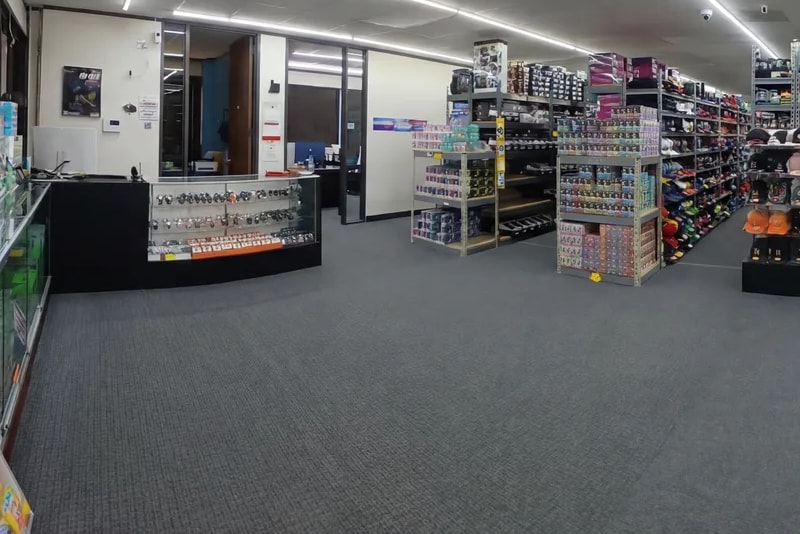
- Keep the highest-value items in the cashier's sightline. A sunglasses tower or earbud display beside the register sells and protects at the same time. Lower-value items such as cables can live on a pegboard near the queue.
- Display one of each, stock the rest behind the counter. For pricier earbuds, a single facing with a "ask the cashier" tag keeps the item visible without leaving a full peg open. See our wireless earbuds guide for counter-ready packs.
- Keep displays full and neat. A tidy, faced display makes a missing piece obvious to staff right away. A messy one hides gaps.
- Watch voids and no-sales on accessory SKUs. If your POS can report them, look for a pattern by shift.
- Match the display to the store's risk tier. A busy, high-risk location might keep accessories only at the counter, while a quieter store can run a full custom display on the floor.
The goal is to keep impulse items where shoppers see them, as covered in our guide to checkout impulse zones, while making it obvious when something goes missing.
Buying smarter helps too
Smaller, more frequent orders mean less backstock sitting in the stockroom where it can be miscounted or go missing. Warner Wireless Gears is a Houston B2B wholesaler for approved retailers, with no minimum on the first order, so you can buy accessories in quantities that match what your counter actually sells. Eligible orders placed by noon Central Time can ship the same business day from Houston when inventory allows. For pricing help on one of the most-taken accessory lines, see how to price sunglasses in a convenience store.
How to buy wholesale from Warner Wireless Gears
- Apply at warnergears.com/register with business and resale documentation.
- Get approved. Complete applications are usually reviewed in about one business day. Full steps are in How to Open a Wholesale Account.
- Order with tier pricing and live stock.
Call 346-606-7722 Mon–Sat 9:30 AM–6:00 PM CT if you'd like a rep to suggest a counter-friendly accessory assortment.
Address: 10165 Harwin Drive, Suite 190, Houston, TX 77036
Web: www.warnergears.com · Email: info@warnergears.com
Sources
- NACS: Reduce Back Office Blind Spots Through Smarter Data Analysis (May 2026; preliminary NACS State of the Industry data: $1,703 shrink per store per month in 2025, about twice 2021)
- NRF: National Retail Security Survey 2023 (average shrink 1.6% in FY2022) and full report PDF (sources of loss: 36% external, 29% employee, 27% process and errors)
- NACS Magazine: Key Trends In Loss Prevention (November 2025)
- NACS Magazine: Loss Prevention Strategies to Protect Your Store (March 2025)
- NACS Magazine: Elevating Loss Prevention in Convenience Stores (February 2026)
Related WWG categories
Warner Wireless Gears LLC: B2B wholesale for approved retailers, not a public consumer storefront.